
London Series MLB Betting Guide: How the UK’s Home Games Affect the Markets
 Available in US
Table of Contents
The One Weekend When Baseball Bets Stop Being a Night Shift
In June 2019 I cleared my Saturday calendar, took the District line to Stratford, and watched the Yankees and Red Sox combine for 50 runs across two games at London Stadium. I had bet the over both days. Both games cashed before the seventh inning. I have followed every London Series since, and the same lesson keeps repeating: when MLB visits the UK, the markets behave differently than they do during a normal Sunday night ESPN game, because the venue is different, the crowd is different, and the public money flowing into UK books is different from what hits American sportsbooks at the same kick-off.
For UK punters, the London Series is the only annual window when you can actually attend an MLB game on home soil, walk to your seat after work, place a bet through a UK-licensed app on your phone, and watch the entire thing on a normal evening rather than at 3am. That accessibility changes how the public bets, which changes how the lines move, which changes where the value sits. The 2026 edition was originally scheduled for Yankees against Blue Jays but ran into venue and broadcasting conflicts I will get to below. Whether or not the series returns next year, the betting patterns it has created over four visits are now part of the MLB market structure for UK punters and worth understanding properly.
A Short History of MLB at London Stadium
The first London Series in 2019 was a genuine event in British sports history. Tickets for the Yankees and Red Sox two-game set – 120,000 across both days – sold out in under an hour when they went on general sale, which tells you everything about pent-up demand for live MLB in the UK. The games themselves produced one of the highest-scoring two-day sequences in the modern era, with both teams treating the unusual dimensions of the converted football pitch like a launching pad.
Covid wiped out the 2020 plans entirely. The series returned in 2023 with Cubs and Cardinals, then continued in 2024 with Mets and Phillies. That 2024 weekend pulled 108,956 fans across two days, and a follow-up commercial review put the economic impact at roughly $67 million for London, with 71% of attendees being British rather than American tourists. MLB merchandise sales in the UK grew 43% year on year in the wake of that weekend, and the league’s UK social channels added subscribers at a 133% growth rate over the same window. Those are not vanity numbers – they are the underlying market that drives the betting volume on these games.
The MLB leadership has been very direct about the strategic intent. Chief operations and strategy officer Chris Marinak told the Associated Press in 2024 that the league has clearly identified the UK as a priority market and an area it plans to emphasise for international growth. Translation: London Series is not a one-off curiosity, it is part of a long-term commercial plan, which is why the cancellation of the 2026 edition with Yankees and Blue Jays – caused by a scheduling conflict between West Ham’s use of the stadium and Fox’s broadcasting obligations around the FIFA World Cup 2026 – was a postponement rather than a retreat. The series will be back.
London Stadium as a Park Factor
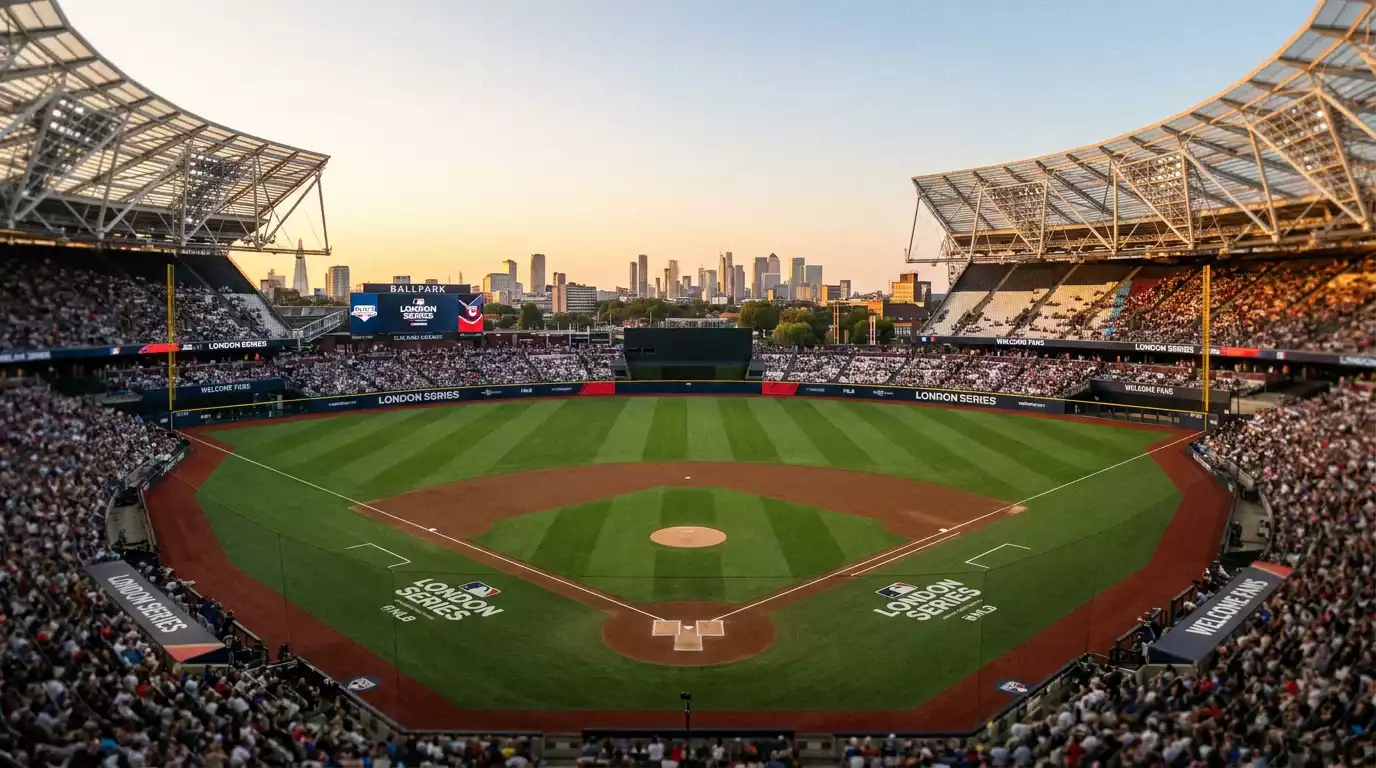
Here is the practical betting point most UK punters miss. London Stadium is a football ground that has been temporarily converted into a baseball diamond. The conversion process moves third base, home plate and the outfield walls into a configuration that is genuinely strange by MLB standards. The dimensions in 2019, 2023 and 2024 were tight in the corners – closer to a small-park profile like Yankee Stadium than to a neutral park like Citi Field – and the artificial turf laid over the football pitch produced unusually fast surface bounce on ground balls.
What that means in betting terms: the London Stadium configuration plays as a hitter’s park, and totals routinely come in elevated relative to what the same two teams would price at in a neutral US venue. In 2019 the over hit on both Yankees-Red Sox games by wide margins. In 2024 the Mets-Phillies series produced four-game crooked-number innings that would have looked unremarkable in a Coors Field-style environment but stood out against the more pitcher-friendly modern average. The mechanism is simple. Short porches plus turf plus jet-lagged pitching staffs produce high-event baseball.
If you are going to bet a future London Series, the first analytical step is to treat the venue as a confirmed hitter’s park until evidence forces revision. Pricing pitchers on their road ERA at neutral parks will systematically underestimate the run environment. The historical pattern across four visits is too consistent to dismiss as a small-sample fluke.
Why London Totals Tend to Spike Above the Number
The hitter-friendly venue is only half of the story. The other half is travel. A team flying from a Friday night home game in the eastern United States across the Atlantic loses a night of sleep, lands in a five-hour time zone shift, and then plays a noon-local first pitch within roughly 48 hours of arrival. Around 30% of MLB games over a normal season are decided by a single run, which means most contests live inside a tight margin where small disruptions translate directly into outcomes. Jet lag is not a small disruption.
The pitching staffs feel this first. Starters lose a tick of velocity on the long ball, command sharpness softens at the edges, and bullpens that were already stretched by mid-season usage get tested by extra innings on an unfamiliar surface. Hitters feel jet lag too, but the bat-on-ball part of the game tolerates fatigue better than the precision required to hit a corner with a four-seamer on the outside black. The asymmetry produces runs.
On top of that, both teams typically arrive having played a Thursday or Friday game in the US, meaning the rotation order has been shuffled and the pitchers starting the London games are not necessarily the matchup the schedule would otherwise have produced. You get number-three and number-four starters more often than aces. That further tilts the total upwards.
How UK Public Money Skews the Line
UK books take notably different action on London Series games than US books do. The British public bets these games with a clear lean: they back the team they have heard of more, they back the bigger market, and they back the over. The Yankees in 2019, the Cubs in 2023, the Mets in 2024 – in each case the marquee club drew the lion’s share of the UK ticket count, and the line on those favourites firmed up at UK-facing prices to a degree that mid-week US action would not have produced.
That public skew creates two practical opportunities. First, the underdog moneyline at UK books frequently offers a few cents of extra value compared with closing prices at major US books, because the UK book is balancing books against heavy favourite ticket counts. Second, the under on the total often gets a slow drift through the day as the recreational money piles onto the over, leaving the under at a price that is a touch better than the true number suggests. Neither edge is enormous, but for punters who shop lines actively across UK and US accounts, the London Series creates one of the cleanest market-bias situations of the year.
The flip side: in-play markets during London Series games can get loose in the wrong direction. A British public that has just turned up for the game and is unfamiliar with bullpen depth charts tends to overreact to early-game scoring, and the live total resets aggressively after a high-scoring first inning. Disciplined under bettors who entered the game with a pre-match position should generally hold rather than chase the live number.
Broadcasting and Line Availability
BBC has carried the London Series on free-to-air television in past editions, which is the single biggest reason for the public-money skew described above. When the games air on BBC, the casual British sports viewer who would never watch a regular-season MLB game suddenly has the option, and a meaningful share of those viewers will place a small bet for engagement. TNT Sports has also held selective MLB broadcasting rights in the UK, and the combination of BBC plus TNT means London Series weekend gets fuller UK media coverage than any other MLB weekend of the year.
For punters, the practical implication is that line availability widens during the series. UK-licensed bookmakers that offer minimal MLB coverage for the rest of the season will roll out enhanced markets – extended props on big-name hitters, run-line variations, first-inning markets, anytime home run – specifically for London Series games. Some of those props are priced softly because the books themselves do not have deep modelling on the unusual park environment, and a punter who has done park-factor work on London Stadium can find genuine edges that simply do not exist in normal markets. If you want to understand the deeper rhythm of the betting calendar that frames the rest of your year around these UK-friendly windows, the practical realities of how to watch MLB from the UK shape how often you can actually act on the work you put into research.
Note that the academic view on whether baseball will take root in the UK is mixed. Boris Helleu, a sports marketing researcher at the University of Caen Normandy, told Associated Press in 2024 that for Europeans the rules of baseball are quite difficult and that American football and basketball are easier to understand and arguably more spectacular. That assessment is fair as a description of the general public, but it is precisely why London Series creates betting value: when the casual money does not understand the underlying mechanics, the prices it produces are exploitable for punters who do.
What to Take Away Before the Next Series
The London Series is a small enough sample that you should not over-engineer your model around four visits worth of data, but the underlying drivers are not random. Tight football-pitch dimensions, fast turf, jet-lagged pitching staffs, public money skewing to favourites and overs, and UK broadcast exposure widening the recreational pool – these are repeatable conditions that will apply whenever the series returns. The right preparation for the next London Series is to start charting venue-specific results now, build a small park-factor adjustment for the conversion-style configuration, and watch for soft prop lines on the bookmakers that do not have deep baseball modelling. When MLB does come back to East London – and it will, despite the 2026 disruption – you want to arrive at the weekend with a clear analytical framework rather than the public-money instincts that will drive the rest of the action.
Was the 2026 London Series confirmed or cancelled?
The 2026 London Series, originally scheduled to feature the Yankees and Blue Jays, was cancelled due to a scheduling conflict between West Ham’s use of London Stadium and Fox’s broadcasting obligations around the FIFA World Cup 2026. MLB has indicated the series will return in a future season; the cancellation was logistical rather than strategic. The UK remains a stated priority market for the league.
Do UK books offer enhanced markets for London Series?
Yes. UK-licensed bookmakers that offer minimal regular-season MLB coverage typically expand their market depth specifically for London Series weekend, adding extended hitter props, run-line variations, first-inning markets, and anytime home run pricing. Some of those props are priced softly because the books lack deep park-factor modelling on the converted football-pitch configuration, which creates genuine edges for prepared punters.
Prepared by the Betting Tips for Baseball editorial staff.