MLB Odds Conversion: Decimal, American and Implied Probability
 Available in US
Table of Contents
- MLB Odds Formats: Translating American Prices for UK Bettors
- Decimal Odds: The Format You Already Trust
- American Odds: The Plus and the Minus That Run the Market
- The Two Formulas That Do All the Heavy Lifting
- Implied Probability: Where the Number Starts to Mean Something
- Three Real-World MLB Scenarios I See Every Week
- What to Take Away Before You Place Your Next MLB Bet
MLB Odds Formats: Translating American Prices for UK Bettors
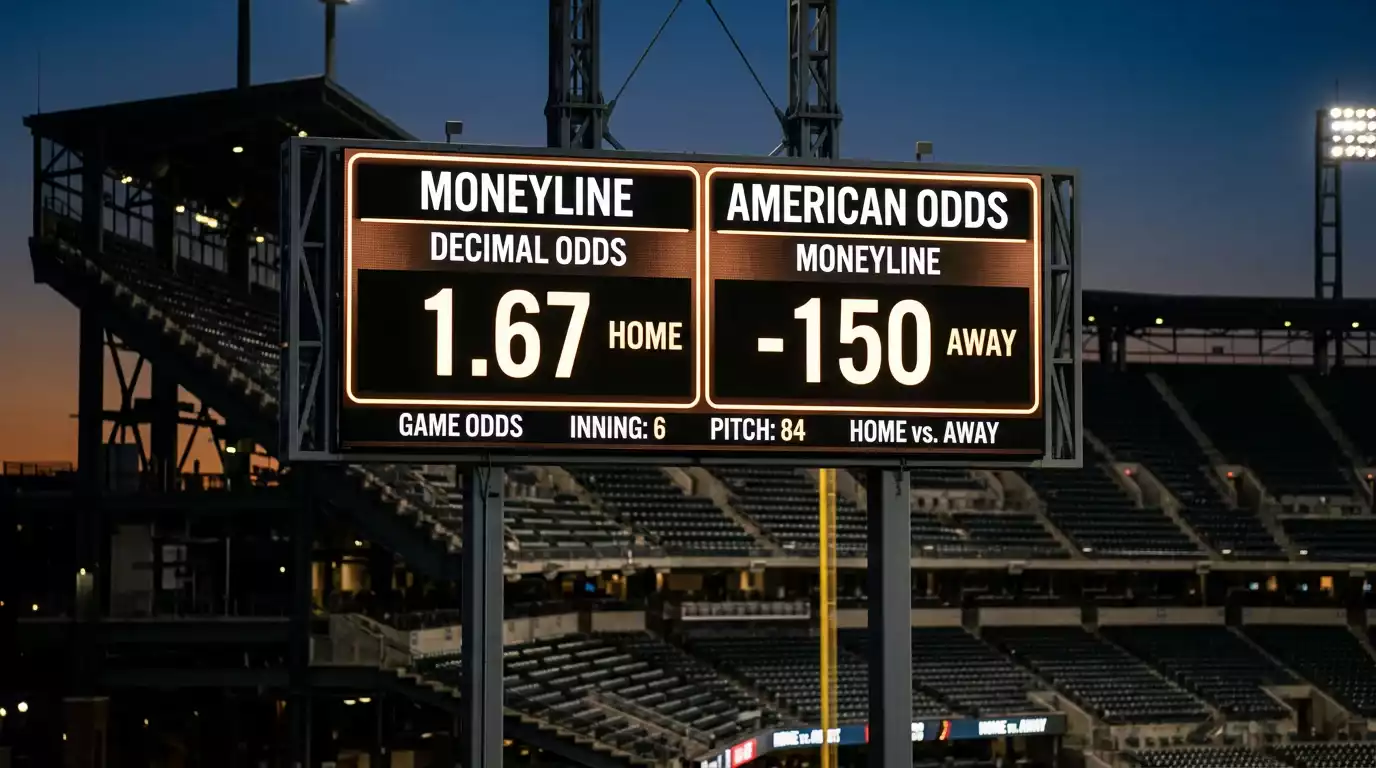
The first time I opened a UK-friendly book on a Yankees-Red Sox game and saw a line listed as -150 instead of 1.67, I assumed the page had loaded wrong. It had not. Many UK sites that carry MLB simply mirror the US convention because the entire upstream feed – the openers, the steam, the closing prices – originates from American markets. If you want to bet baseball seriously from the UK, you need to be fluent in both formats, not just one.
This is not a deep statistical piece. It is a working reference I wish someone had handed me when I started covering MLB markets for British readers eleven years ago. We will go through decimal, American positive, American negative, the conversion formulas in both directions, implied probability, and three worked scenarios you can copy into a spreadsheet today. About 30% of all MLB games are decided by a single run, which means the gap between -130 and -150 in moneyline terms is not cosmetic – it is the difference between a profitable season and a flat one.
Decimal Odds: The Format You Already Trust
If you have placed a single football bet at a UK book, you already understand decimal odds. I still remember the relief on a colleague’s face when he realised the format he had used for fifteen years on Premier League accumulators worked identically for a Dodgers run line. Nothing changes about the maths. The number is your payout multiplier per unit staked, returned stake included.
Take a price of 1.91. Stake ten pounds, win, and you collect 19.10 back – that is 9.10 in profit plus your tenner. A price of 2.30 returns 23 on a ten-pound winner: 13 profit, 10 stake. The greater the number, the bigger the underdog. Anything under 2.00 is the favoured side. Anything above is plus-money. The break-even threshold for a 50/50 proposition without bookmaker margin is exactly 2.00, which is why you almost never see it offered – the vig has to sit somewhere.
What trips British punters up on MLB is not the maths but the spread of typical prices. Premier League moneylines cluster between 1.30 and 6.00 across three-way markets. Baseball moneylines hover between 1.40 and 3.50 across two outcomes, with a third-way tie option occasionally appearing for nine-inning markets. The volatility looks compressed because the underlying sport produces those single-run games at such a high rate.
American Odds: The Plus and the Minus That Run the Market
American odds tell you one of two things depending on the sign attached. A minus number tells you how much you need to risk to win 100 units. A plus number tells you how much you win on a 100-unit risk. The unit is not literally dollars – it is just a reference figure, and the maths scales linearly. This is the convention every US sportsbook uses, and almost every American-derived feed pumps these numbers into UK-facing books before they are converted on display.
So -150 means staking 150 to win 100, returning 250 in total. The same line as decimal is 1.67. Move to -200 and you are staking 200 to win 100, returning 300, which equals 1.50 decimal. The bigger the minus number, the heavier the favourite, and the smaller the decimal odds.
The plus side works in reverse. A price of +130 means risking 100 to win 130, returning 230, which is decimal 2.30. A line of +180 returns 280 on a 100 stake, decimal 2.80. The bigger the plus number, the longer the underdog, and the larger the decimal odds.
Where many punters slip up is at the pivot – when a line crosses from -110 to +100 to +110. The change feels gradual to American eyes because the number simply ticks up. In decimal it looks like a sudden jump from 1.91 to 2.00 to 2.10, because the format compresses around even money. Same line, same value, different optical effect.
A Quick Memory Trick
I keep a sticky note on my second monitor with two anchor points: -110 equals 1.91, and +100 equals 2.00. Once you have those two in your head, everything else is interpolation. Anything more lopsided than -110 sits below 1.91. Anything longer than +100 sits above 2.00. After a season of this, you will read both formats without thinking.
The Two Formulas That Do All the Heavy Lifting
You only need two equations. One converts American to decimal. The other converts decimal back. Memorise them once and the rest of this article is mechanical.
For negative American odds, the formula is decimal equals 100 divided by the absolute value, then plus one. So -150 becomes 100 divided by 150, which is 0.6667, plus 1, giving 1.67. For -200 you get 100 divided by 200, which is 0.5, plus 1, giving 1.50. For -110 you get 100 divided by 110, which is 0.909, plus 1, giving 1.91.
For positive American odds, the formula is decimal equals the American number divided by 100, then plus one. So +130 becomes 130 divided by 100, which is 1.3, plus 1, giving 2.30. For +180 you get 1.8 plus 1, which is 2.80. For +250 you get 2.5 plus 1, which is 3.50.
Going the other way is just as clean. For decimal odds at 2.00 or above, the American equivalent is decimal minus one, multiplied by 100. So 2.30 minus 1 equals 1.3, times 100, equals +130. For decimal odds below 2.00, the American equivalent is negative 100 divided by decimal minus one. So 1.67 – that’s 100 divided by 0.67, which equals -149.3, rounded to -150 at the book.
If you are building a spreadsheet, the formulas above plug straight into two cells. I use a single shared workbook for every MLB game I track, and the conversion column has not changed since 2018. The American input goes in column A; column B does the conversion; column C does my implied-probability calculation; column D shows my estimated edge.
Implied Probability: Where the Number Starts to Mean Something
Once you can convert formats, the next step is asking what the price is telling you about the bookmaker’s view of the outcome. Implied probability is decimal odds inverted – one divided by the decimal price, expressed as a percentage. A 1.67 line implies a 59.9% chance the side wins. A 2.30 line implies 43.5%. A 1.91 line implies 52.4%, which is why -110 is the standard book line for what should be a true coin flip: the extra 2.4 percentage points are the vig.
The arithmetic is identical in American format, just longer. For -150, the implied probability is 150 divided by 150 plus 100, which equals 60%. For +130, it is 100 divided by 130 plus 100, which equals 43.5%. Note that the two sides of a moneyline almost never add to exactly 100%. They add to 104%, 106%, sometimes 109% on tighter player props. That overround is the bookmaker margin, and it is what you need to strip out before judging whether a price represents value.
Devigging – removing the overround – is the next step beyond simple conversion, and it deserves its own treatment. I have written a longer breakdown of how to find value through implied probability and devigging for anyone ready to push past the surface maths. For this article, the point is simpler: if you cannot tell at a glance that -150 implies roughly 60% and +130 implies roughly 43.5%, you cannot tell whether your own estimate of the true probability beats the line. Format fluency is step one. Value comes later.
Three Real-World MLB Scenarios I See Every Week
Last year Americans wagered $166.94 billion on sport, an 11% jump on the prior year, and a sizeable chunk of that volume flowed through MLB markets that UK punters now mirror via UKGC-licensed books. The numbers below are the kinds of lines I work with on a typical Tuesday in July.
Scenario one: an interleague day game. The home team opens as a -140 moneyline favourite with a strong starter on full rest. In decimal, that’s 100 divided by 140 plus 1, which equals 1.71. Implied probability sits at 58.3%. The road underdog is priced +120, decimal 2.20, implied 45.5%. The two sides add to 103.8% – a relatively tight 3.8% overround, which suggests a competitive market with sharp action already in.
Scenario two: the run line on the same game. Home team -1.5 is offered at +130, which is decimal 2.30, implied 43.5%. Road team +1.5 sits at -150, decimal 1.67, implied 59.9%. Because around 30% of MLB games end with a margin of exactly one run, the run-line market always shifts the price dramatically, and a UK punter who instinctively reaches for the favourite moneyline at 1.71 has to compare it directly with 2.30 on the same side, just shifted by 1.5 runs.
Scenario three: a total. The over 8.5 is priced -115, decimal 1.87, implied 53.5%. The under 8.5 is priced -105, decimal 1.95, implied 51.3%. The two add to 104.8%. The market is slightly tilted to the over, possibly reflecting a weather forecast or a weak bullpen on one side. The decimal numbers make the asymmetry visible immediately. The American numbers make it look like a coin flip until you read the sign.
None of these calculations took more than thirty seconds with a calculator app open. After a week of doing them by hand, you stop needing the calculator at all.
What to Take Away Before You Place Your Next MLB Bet
Format fluency is the entry-level skill for serious baseball betting, and it is the one most UK punters skip because it feels too basic to bother with. It is not. Every line-shop comparison, every value calculation, every comparison between a Friday opener and a Sunday closer relies on you reading two numbers at the same speed. If you have to pause and convert, you are slower than the market, and the market is fast. Memorise -110 equals 1.91 and +100 equals 2.00. Keep the two formulas in a spreadsheet. Practise on three games a night until the conversion is automatic. The rest of MLB betting – implied probability, devigging, closing-line value, run line construction – gets easier the moment the format stops being a friction point.
Why do some UK books still display fractional odds for MLB?
A handful of long-established UK operators default to fractional odds because their traditional sportsbook audience is wired for football and horse racing displays. For MLB the practice is becoming rare; most UK-licensed books now offer at least decimal as a toggle, and some only show decimal. If your book still presents 4/6 instead of 1.67, switch the display in your account settings – every modern UK-facing operator I have used in the last three years has the option.
How do alternative run lines look in decimal vs American?
An alternative run line shifts the standard 1.5 to a different number, typically 2.5 or even 3.5, and adjusts the price accordingly. So a -2.5 alt run line on a heavy favourite might be priced +160 American, which is decimal 2.60. The +2.5 alt run line on the underdog at the same book might be -190 American, which is decimal 1.53. The same two conversion formulas apply – nothing changes about the maths just because the line has shifted.
Written by the editors at Betting Tips for Baseball.