MLB Pace-of-Play Rules Betting Impact: The Pitch Clock Era
 Available in US
The Two-Hour Game That Changed UK Betting
My first MLB game-watching habit was built around four-hour evenings. The Yankees and Red Sox would play a game that stretched from a midnight UK first pitch until past 4am, with extended commercial breaks, lazy between-innings pacing, and pitchers wandering around the mound between pitches as if they had all night. By 2023 the average game time had dropped substantially. By 2025 the MLB regular season average sat at 2 hours and 38 minutes – three consecutive seasons of average game length at or below 2:40 for the first time since 1983 to 1985. The game I watch from London today finishes before the game I used to watch had reached the seventh inning. That is not a small change. That is a structural shift in how MLB plays out, and the betting implications run across every market category from in-play timing to bullpen usage to total game length.
For UK punters who built their MLB betting habits in the pre-clock era, the pitch-clock rules have changed the analytical landscape in ways that are easy to underweight if you have not actively recalibrated. Faster games mean different in-play rhythms, different starter-to-bullpen handoff patterns, different fatigue distributions across the late innings, and different game-duration prop markets. This article walks through each of those shifts with the betting application in plain terms.
What the Pitch Clock Rules Actually Do
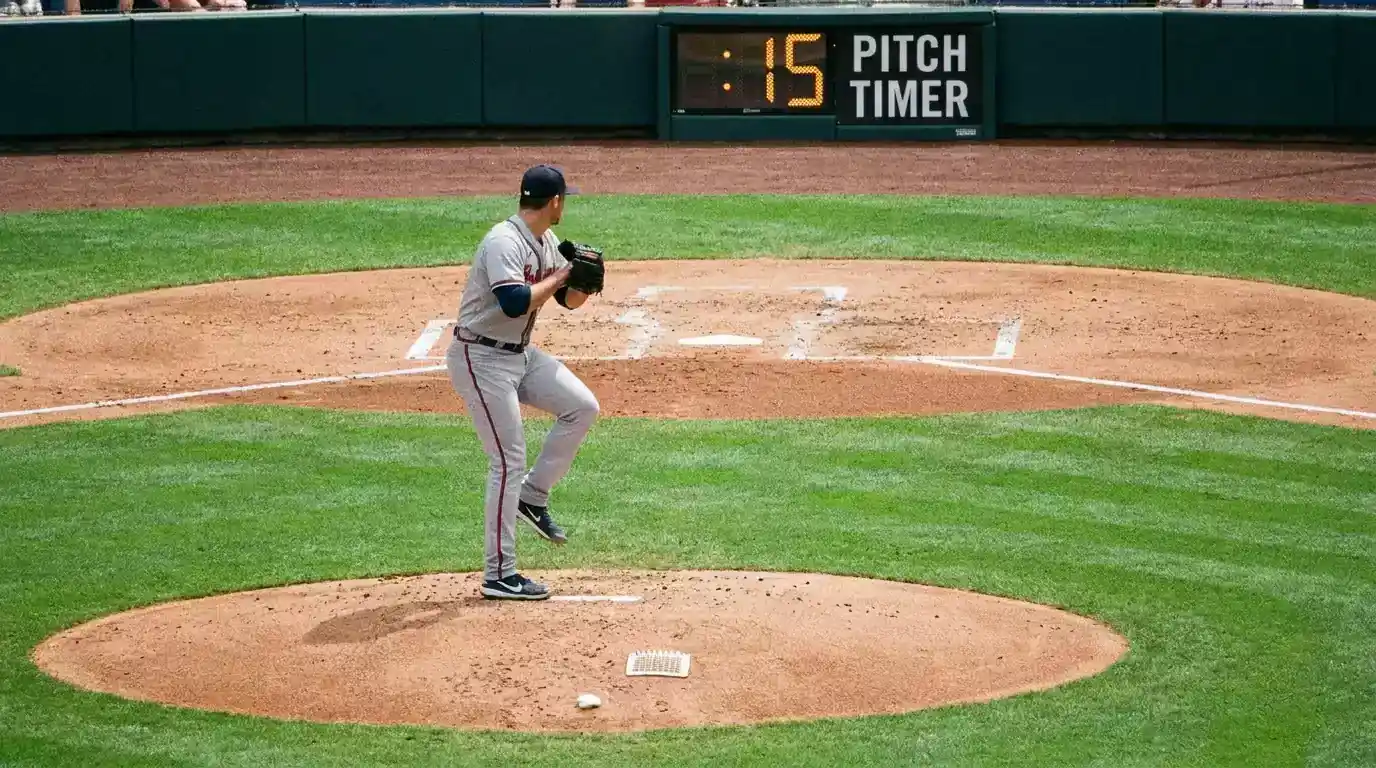
The pitch clock that MLB introduced in 2023 sets a hard time limit between pitches. With the bases empty, the pitcher has 15 seconds from receiving the ball back from the catcher to begin his delivery. With runners on base, the limit extends to 18 seconds. The hitter has separate timing requirements – he must be in the batter’s box and alert with 8 seconds remaining on the clock or face an automatic strike.
The enforcement mechanism is direct. A pitcher who fails to begin his delivery within the time limit is charged with an automatic ball, which gets added to the count regardless of what the catcher and pitcher were actually preparing to throw. A hitter who fails to be ready within the timing requirement is charged with an automatic strike. The rule applies across the entire regular season and post-season, with no exceptions for high-leverage situations or marquee broadcast games.
The cumulative effect across a nine-inning game is significant. The previous era’s typical 12-15 seconds of dead time between pitches has been compressed to 4-7 seconds of actual time spent waiting for the pitcher to be ready. Multiplied across roughly 280 pitches per game, the time savings amount to roughly 40-50 minutes per game. Combined with parallel rule changes around mound visits, pickoff attempts, and pitching changes, the total impact has pushed average game time from approximately 3:04 in 2022 to approximately 2:38 in 2025.
The pitch clock has not measurably affected offensive output in either direction. Scoring rates have remained roughly stable across the rule transition. The strikeout rate has held steady. The home-run rate has held steady. The rule has produced shorter games without producing material changes in the underlying offensive environment – which is structurally important to understand for totals betting purposes.
Average Game Time by Season
The trajectory of game length has been one of the most striking statistical shifts in modern MLB. The 2022 season produced an average game time of 3:04, which itself was already shorter than the 2021 figure of 3:11. The 2023 season – the first with the pitch clock in effect – dropped to 2:40, a 24-minute reduction in a single season. The 2024 season held steady at approximately 2:36. The 2025 season produced 2:38, completing three consecutive seasons at or below 2:40 – the first such stretch since 1983-85.
The consistency of the post-clock average game length suggests the new equilibrium is stable. Players have adjusted their pre-pitch routines. Pitchers have internalised the timing requirements. Hitters have settled into the more compressed batter’s box rhythm. The volatility of the first transition season has given way to a steady-state shorter game, and bettors should expect this to persist absent further rule changes.
The interaction with viewership has been positive for MLB. ESPN’s Sunday Night Baseball in 2025 averaged 1.8 million viewers per game, the best season in 12 years and a 21% year-on-year increase. The shorter game format is more digestible for casual viewers, which has clear commercial implications for the sport but also affects the betting landscape – higher viewership translates to higher recreational money flow, deeper markets at recreational books, and softer prices on the games that get the highest national broadcast attention.
How Faster Games Change Bullpen Usage
The most consequential betting implication of the pitch clock is the indirect effect on bullpen usage. Faster games produce starters who throw their typical pitch count in fewer minutes of work, which means starters are less physically depleted in the late innings than their pre-clock equivalents. The metric that shifted with the rule change was not pitch count itself – starters still throw roughly 90-100 pitches per outing – but the time over which those pitches are thrown.
The cumulative effect is that starters now pitch deeper into games than they did in the pre-clock era. The seventh-inning starter has become more common. The eighth-inning starter, while still rare, occurs more frequently than it did in 2021. The earlier bullpen handoffs that defined the pre-clock late-game rhythm have shifted later by roughly half an inning on average.
For betting purposes, this has direct implications. Starting pitcher prop markets – innings pitched, strikeouts recorded – have shifted upward in the post-clock era. The recreational money has not always adjusted to the new baseline, which means the over on starting pitcher innings props is a more reliable position than it was pre-2023. Pitching dominates win-percentage prediction in modern baseball, and the extended starter usage compounds the structural advantage that strong-rotation teams hold.
The reverse implication matters for bullpen-dependent teams. A team whose strategy depends on early starter pulls and aggressive multi-reliever sequencing has had its operational baseline disrupted by the rule change. The seventh-inning matchup specialist is harder to deploy when the starter is still on the mound with reasonable stuff. The total team-pitching workload distribution has shifted in ways that bullpen-centric front offices have had to rework. As Max Scherzer noted in a 2025 FanGraphs interview about modern pitching philosophy, the game has increasingly become about thinking like robots while trying to make decisions based on another human being in a box – and the pitch clock adds an additional layer of robotic-versus-human tension that pitchers and managers continue to negotiate.
Impact on In-Play Betting Rhythm
The in-play markets have been materially reshaped by the faster game pace. In the pre-clock era, the typical between-pitch window of 25-35 seconds gave punters enough time to assess the count, check the prop board, and place a wager with deliberation. The current 15-second between-pitch window with bases empty has compressed that decision-making window to the point that in-play betting requires meaningfully faster reaction times than it used to.
The bookmaker books have responded by automating their in-play pricing more aggressively, with shorter live-betting windows around individual at-bats and faster re-pricing after each pitch outcome. The recreational punter who in 2021 could place an in-play bet at a leisurely pace now needs to act decisively within a sub-15-second window or miss the price.
For UK punters running pre-match-only strategies, the faster in-play markets are not directly relevant – but the indirect effect matters. The closing-line value of pre-match positions can now be assessed against in-play opening prices more quickly than it used to, which means line-shopping within games is more time-pressured than the pre-clock baseline. Setting up automated price alerts has become more useful than it was in the slower-paced era.
Time-of-Game and Novelty Props
The bookmaker books have introduced time-of-game prop markets in response to the new shorter-game equilibrium. The over/under on total game time as a betting market has become available at several UK-licensed operators, with typical lines sitting around 2:35 to 2:45 depending on the specific matchup, starting pitchers, and projected total runs.
The interesting betting angle on game-time props is the structural relationship between expected total runs and expected game length. Low-scoring matchups with two high-strikeout starters tend to finish faster than the typical line suggests, because strikeouts run shorter in time than balls-in-play outcomes that involve baserunners and defensive plays. High-scoring matchups with weaker starters and frequent bullpen changes tend to extend toward longer game lengths because each pitching change adds 90 seconds to several minutes of additional in-game time.
The over on game time correlates strongly with the over on total runs, which means the two markets should not be bet as independent positions – they are essentially the same wager priced through different mechanics. The slight pricing inefficiencies between the two markets at specific bookmakers can produce small arbitrage-style opportunities for punters who track both prices simultaneously. The natural complement to pace-of-play analysis is the broader question of how league-wide audience growth is reshaping the entire betting market depth picture. The realities of why audience growth matters to UK MLB punters sit as the natural closing layer of the modern-game analytical framework.
Adjusting Your Mental Model for the Clock Era
The right discipline for UK punters is to internalise the post-clock environment as the operating baseline. Treat the 2:38 average game length as the new normal. Adjust starter prop expectations upward to reflect the deeper-into-games rotation usage. Calibrate in-play strategy expectations for faster decision windows. Use game-time props as a parallel framing of total-runs analysis. The pitch clock has been in effect long enough that the new equilibrium is stable, and the bettors who continue to operate from pre-2023 mental models are betting against the structural reality of how the game now plays.
Has the pitch clock affected over/under totals?
No, not directly. Scoring rates have remained roughly stable across the pitch-clock transition. The strikeout rate, walk rate, and home-run rate have all held steady within normal year-to-year variance. The rule changes shortened games without affecting the underlying offensive environment, which means totals lines have not needed to adjust for the rule change itself. The indirect effect through extended starter usage and shifted bullpen handoffs has had some modest impact on game-by-game pricing but no material league-wide totals adjustment.
Are pitch-clock violation props offered in the UK?
Specific pitch-clock violation props are rare at UK-licensed bookmakers. The market is too thinly developed and the data too granular for most operators to price reliably. A small number of specialist books have offered occasional novelty props on total pitch-clock violations in marquee broadcast games, but these are not part of standard daily MLB market offerings. Game-time over/under markets are more widely available and serve as the indirect way to bet on pace-of-play outcomes.
Written by the editors at Betting Tips for Baseball.