
MLB Responsible Gambling Tools for UK Punters: Limits, Time-Outs and GamStop
 Available in US
Table of Contents
- The Reason MLB Needs More Discipline Than Football
- Deposit Limits: The First Tool to Set
- Loss and Wager Limits as Separate Controls
- Time-Outs and Cooling-Off Periods
- GamStop and National Self-Exclusion
- Monitoring Your Own Play Before the Tools Become Necessary
- How These Tools Fit Into MLB’s Calendar
- The Habit That Works Across Every UK Punter’s Routine
The Reason MLB Needs More Discipline Than Football
A reader once wrote to me after a particularly bad week: he had bet every MLB game for two straight weeks, lost money on roughly half of them, and ended the fortnight chasing his initial losses with bets he no longer believed in. He had bet zero football games in the same period. The contrast told the whole story. MLB plays 162 regular-season games, with each team playing nearly every day from late March through early October. Football gives you one or two fixtures per club per week. The pacing of opportunity is completely different, and the discipline required to bet baseball over a long season is a different category of challenge from the discipline required to bet European football.
For UK punters new to MLB, the high game volume is the single biggest practical risk factor. Every operational responsible-gambling tool – deposit limits, loss limits, time-outs, self-exclusion – was designed with high-frequency betting patterns in mind, and the relevance to a serious MLB bettor is direct. Recent UK survey data confirms what experienced bettors already suspect: 21.9% of 18 to 24 year-olds score on the PGSI scale, with the highest engagement in high-frequency online products, and 48% of UK adults engaged in some form of gambling activity in the prior four-week window. The infrastructure exists precisely because the high-frequency patterns produce predictable harm absent active management.
Deposit Limits: The First Tool to Set
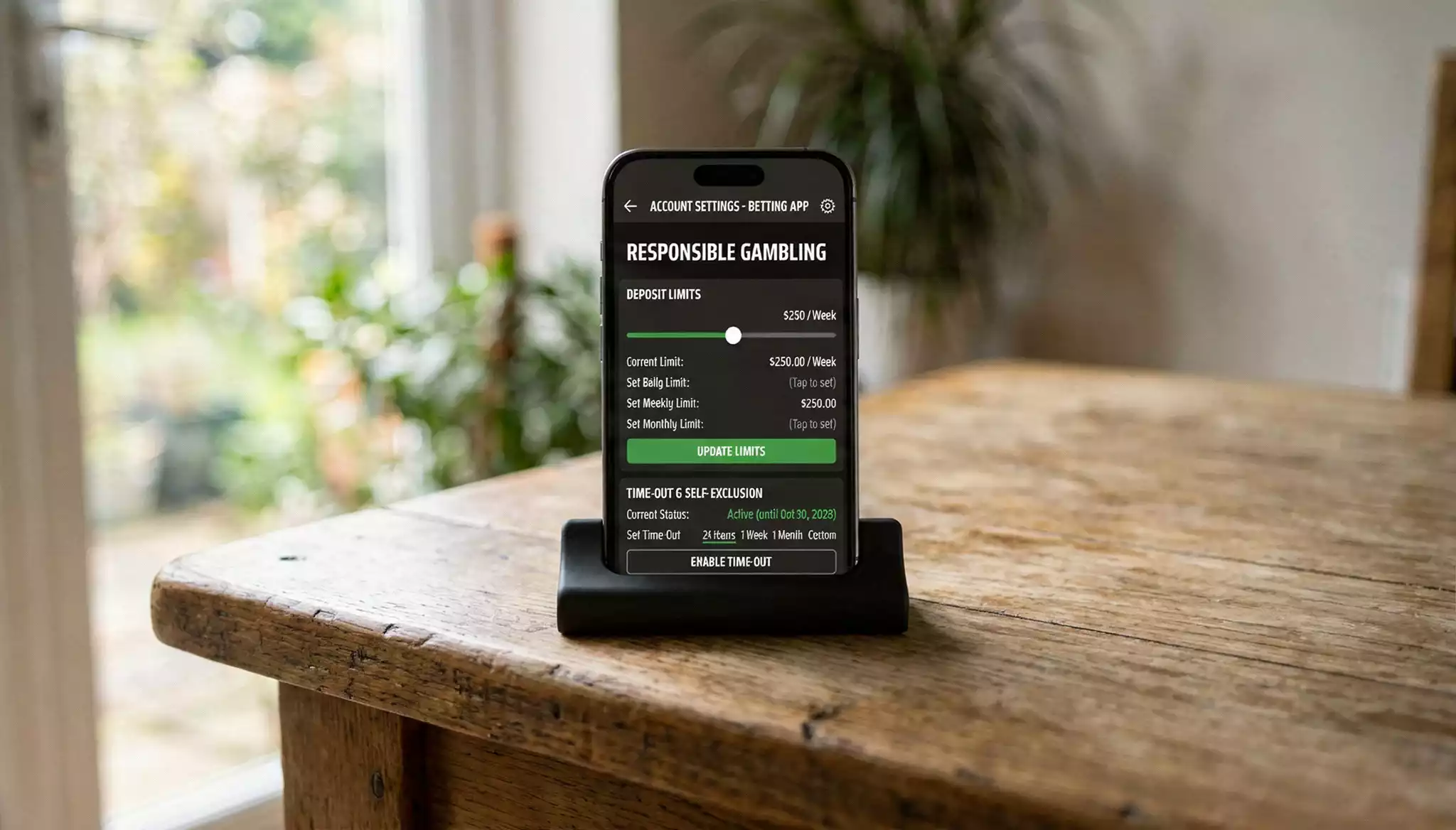
Every UKGC-licensed operator must offer deposit limits across three time windows: daily, weekly, and monthly. The mechanic is the simplest possible – you set a maximum total deposit amount for the chosen window, and the system blocks any deposit attempt that would exceed the limit. The block holds for the full window. A daily limit resets at midnight UK time. A weekly limit resets at midnight on the chosen reset day. A monthly limit resets on the calendar month boundary.
The advantage of deposit limits over post-hoc bankroll discipline is structural. A deposit limit forces you to confront your bankroll allocation decision before you place any bet, rather than in the heat of a losing session when judgment is at its weakest. The limit you set on a Sunday evening when you are thinking clearly is the limit that protects you on a Friday night when you are tempted to chase. This is why operators are required to ask you about your limit settings at sign-up and to remind you periodically – the regulatory framework recognises that the decision is easier when you are removed from the emotion of active play.
For an MLB bettor, the practical setting depends on bankroll size and intended stake structure. A bettor with a monthly bankroll of £200 might set a £200 monthly deposit limit, which mechanically prevents over-funding. A bettor with a larger bankroll and a more frequent staking pattern might split across daily and weekly limits to constrain both per-session and per-week exposure. The choice depends on your specific routine; the principle is to set the limit deliberately rather than leaving it unconfigured.
Raising a deposit limit takes a 24-hour cooling-off period at most UK books – a regulatory protection designed to prevent in-the-moment escalation. Lowering a deposit limit usually takes effect immediately. The asymmetry is intentional.
Loss and Wager Limits as Separate Controls
Many UK operators offer loss limits as a separate control from deposit limits. A loss limit caps the total amount you can lose within a chosen time window, regardless of how many deposits you make. The mechanic is more sophisticated than a deposit limit: the system tracks your net position across the window, and once cumulative losses reach the cap, betting is suspended for the remainder of the window.
Loss limits handle a specific scenario that deposit limits do not. A bettor who deposits £100, wins back £150, and then loses £300 has experienced £150 in losses but only £100 in deposits. A deposit limit set at £100 weekly would not have constrained the second leg of the activity. A loss limit set at £100 weekly would have. The two tools address different failure modes, and many disciplined UK punters use both in combination.
Wager limits are a third variant available at some operators. A wager limit caps the total amount staked across all bets within a window, regardless of outcome. This is the strictest of the three controls because it counts wagers whether they win or lose. A bettor who places £500 in bets across a week, wins £400 and loses £600, has wagered £500 total even though net losses are £200. A wager limit at £500 weekly would prevent any further bets after the threshold is reached. The strictness makes wager limits less commonly used than deposit or loss limits, but they have a place in routines where session-volume control matters more than financial exposure.
Time-Outs and Cooling-Off Periods
Time-outs are temporary self-exclusions ranging from 24 hours to six weeks. The mechanic is straightforward: you select a duration, confirm the choice, and the operator blocks your account from any betting activity for that period. Existing bets continue to settle in the normal course; you simply cannot place new wagers or deposit funds until the time-out expires.
The use case for time-outs is specific. After a losing stretch that has produced uncomfortable emotions – frustration, anger, the urge to chase – a 24-hour time-out forces a hard break before the next betting session. The cool-off interrupts the pattern of compulsive engagement and restores the deliberative spacing that healthy betting requires. A 48-hour time-out around a particularly bad weekend gives an even cleaner reset. A six-week time-out is a more substantial commitment, often used to navigate a specific personal period where betting is likely to be counterproductive.
Time-outs at one operator do not block other operators. If you have accounts at three UK books, a time-out at one continues to allow betting at the other two. This is a structural limitation of single-operator time-outs that GamStop addresses through cross-operator exclusion, discussed below.
The administrative friction of activating a time-out is intentionally low. Most operators have a single-click activation button in the responsible-gambling section of the account dashboard. The activation cannot be reversed before the time-out expires – once you have confirmed the choice, the block holds until the end of the chosen period. This irreversibility is what makes the tool effective.
GamStop and National Self-Exclusion
GamStop is the UK’s national self-exclusion scheme. Registration with GamStop blocks the registered individual from accessing any UKGC-licensed online operator for the chosen exclusion period – six months, one year, or five years. The block is implemented at the regulatory level, meaning every UK-licensed operator is required to enforce it, regardless of which specific operator the individual originally engaged with.
This is a structurally different tool from operator-level controls. A GamStop registration is a single decision that produces market-wide exclusion. A bettor who registers for a six-month GamStop exclusion is excluded from every UKGC-licensed online operator for six months, with no ability to circumvent the exclusion by signing up at a competitor.
The exclusion holds regardless of whether the registered individual attempts to access existing accounts or open new ones. Operators are required to identify and reject GamStop-registered users at sign-up and at attempted log-in. The enforcement infrastructure is robust enough that circumvention attempts fail at the regulated UK perimeter, although individuals who deliberately seek out unregulated offshore sites can still access gambling activity outside the GamStop framework.
GamStop registration is the strongest single tool in the UK responsible-gambling infrastructure. It is also irreversible during the chosen exclusion period – once registered, the individual cannot opt out of the exclusion before the chosen duration expires. The irreversibility is a deliberate feature. A bettor who is uncertain whether GamStop registration is appropriate should generally choose a shorter operator-level time-out first, escalating to GamStop only when the longer-duration cross-operator commitment is genuinely the right intervention.
Monitoring Your Own Play Before the Tools Become Necessary
The most valuable habit is the one that prevents the responsible-gambling tools from becoming necessary in the first place. A handful of behavioural signals are worth tracking against your own MLB betting routine across a season.
Time spent betting is the cleanest single signal. If your typical session length is creeping upward – from 30 minutes to 60 to 90 – that is information worth using. The pattern of progressive session lengthening is one of the earliest indicators that bankroll discipline is slipping.
Frequency of out-of-routine bets is another signal. If you usually bet two or three games per evening based on prepared analysis, but find yourself placing five or seven bets including markets you did not analyse, the routine has degraded. The bets you placed outside your prepared analysis are the bets that account for the volatility increase that follows.
Chasing behaviour is the most dangerous pattern. If you find yourself increasing stakes after losses in an attempt to recover the losing position, the pattern needs to stop immediately – through a time-out if necessary. The mathematics of chasing are unforgiving. Doubling your stake after a loss does not double your expected return; it just doubles your variance, which means recovery is statistically less likely than a deeper drawdown.
The Wave 3 PGSI screening data underscores why the elevated risk in the 18 to 24 cohort matters operationally. The 5.3% problem-tier rate in that age band is more than four times the rate in older cohorts, and the pattern is partially explained by the same behavioural signals – longer sessions, more out-of-routine bets, more chasing – that any age cohort can fall into without the structural protections that the responsible-gambling tools provide.
How These Tools Fit Into MLB’s Calendar
The MLB calendar amplifies the relevance of every responsible-gambling tool because of its sheer length. The regular season runs roughly 180 days. The postseason adds another month. During the season, every team plays nearly every day, with most evenings offering eight or ten games for a UK punter to choose from. The pacing of opportunity is unforgiving compared to football.
The disciplined response is to treat the operator-level tools as default-on rather than emergency-only. A weekly deposit limit set at a comfortable level, a monthly loss limit set at the bankroll commitment you are willing to lose entirely, and a willingness to use time-outs after rough stretches – those three elements form a structural protection that operates across the season without requiring constant attention. The London Series weekend, when UK punters tend to bet more than usual on a marquee local event, is one of several seasonal high-engagement moments where the tools earn their keep. I have written more about how the London Series specifically affects UK MLB betting markets, but the broader pattern is consistent – high-engagement moments amplify the importance of the structural protections that you set up calmly in the off-season.
The Habit That Works Across Every UK Punter’s Routine
Take ten minutes today, before your next MLB session, to review the responsible-gambling settings at every UK book where you hold an account. Set deposit limits that match your bankroll plan rather than leaving them blank. Configure loss limits if your operator offers them. Bookmark the time-out and self-exclusion options so you know where they are when you need them. The infrastructure exists because the population-level data shows it produces measurable harm reduction. The bettor who uses these tools is a more disciplined bettor than the one who does not. That is the entire point, and the framing applies regardless of whether your individual betting routine has ever approached anything resembling a problem pattern. Discipline before incident is always cheaper than discipline after incident.
Does GamStop block all MLB markets across UK-licensed books?
Yes. GamStop is a regulatory-level self-exclusion scheme that applies to every UKGC-licensed online operator. A registered exclusion blocks access to all UK-licensed online betting sites for the chosen duration – six months, one year, or five years – regardless of the specific sport or market category. MLB markets are not separately excluded; they are part of the comprehensive market-wide block that GamStop registration produces.
Can I set a daily limit that auto-resets at midnight UK time?
Yes. The standard deposit-limit configuration at UKGC-licensed operators allows daily limits that reset at midnight UK time automatically. Some operators offer additional configuration options around reset timing, but the midnight UK time reset is the default and the most commonly used setting. The auto-reset means you do not need to manually re-enable the limit each day – it operates continuously until you choose to modify or remove it, with a 24-hour cooling-off period required for any increase.
Written by the editors at Betting Tips for Baseball.