NPB Betting Tips: How Japanese Baseball Differs From MLB for UK Punters
 Available in US
The League That Made Me Re-Learn Baseball
The first NPB game I bet seriously was a Yomiuri Giants-Hiroshima Carp matchup, and I priced it like an MLB game. I lost the wager because I had no idea that the game could end in a tie after twelve innings. The score stayed level, the umpires called it, and my over-under hedge that depended on a thirteenth inning never got played. That was a useful lesson, paid for in cash. NPB is not a smaller version of MLB. It is a structurally different competition with different rules, different roster construction, and different statistical baselines. If you arrive with MLB instincts and do not adjust, the markets will punish you systematically.
For UK punters, NPB also happens to be the most time-zone-friendly professional baseball on the planet. First pitches in Japan typically fall at 6pm or 7pm Japan Standard Time, which translates to 9am or 10am British Summer Time. You can have your coffee, do an hour of pre-match work, and place positions on a full Japanese slate before lunch. International viewing of professional baseball is rising – MLB streaming alone grew 18% year on year in 2024 – and that broader interest pulls UK book attention towards NPB markets that did not exist five years ago. The window is opening. The punters who can think clearly about Japanese baseball will find more value here than in late-night MLB action.
The Structure of Nippon Professional Baseball
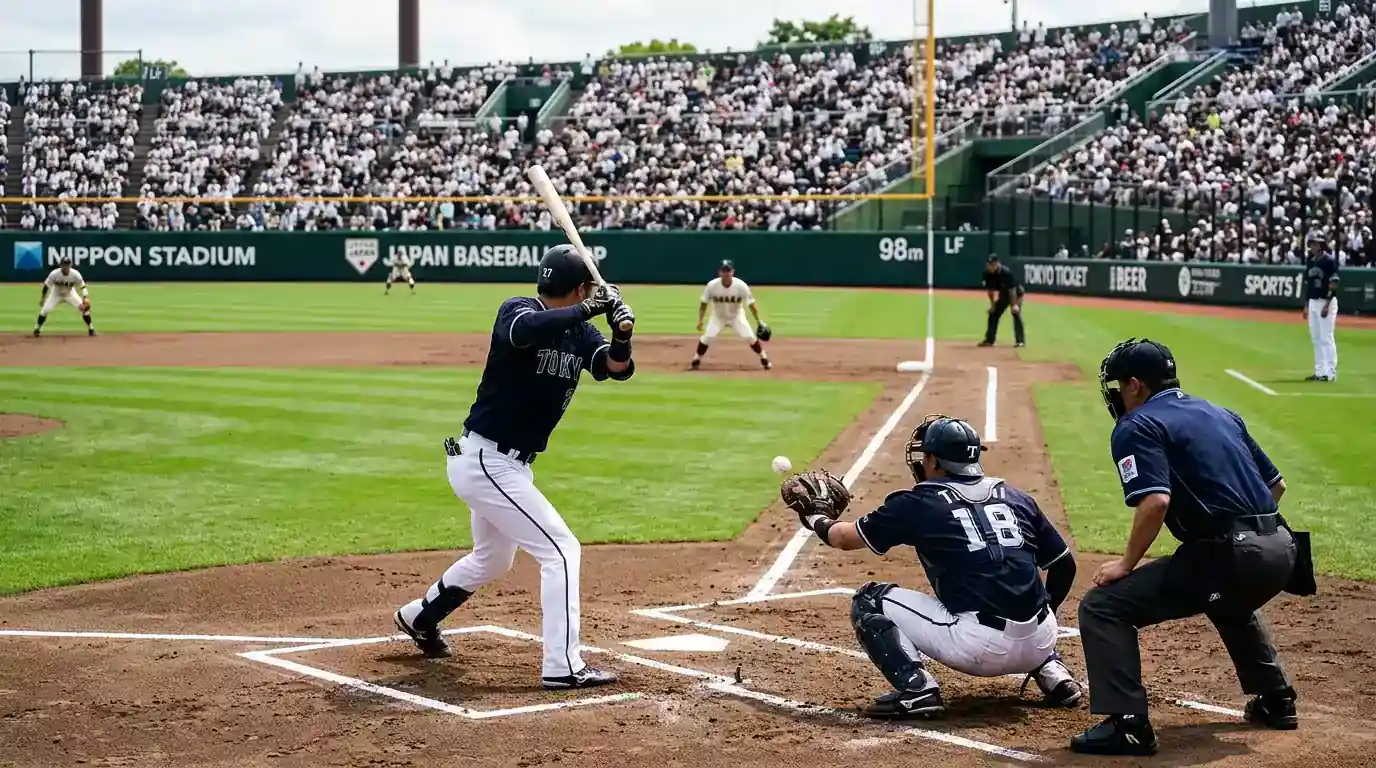
NPB is organised into two leagues of six teams each: the Central League and the Pacific League. The Central League is the more traditional setup, with the Yomiuri Giants as the historic flagship club, the Hanshin Tigers as the loud and chaotic counterweight, and clubs in Hiroshima, Nagoya, Yokohama and Tokyo rounding out the table. The Pacific League features the SoftBank Hawks, Lotte Marines, Rakuten Eagles, Nippon-Ham Fighters, Saitama Seibu Lions and Orix Buffaloes, and has historically been the more analytically progressive side of Japanese baseball with stronger pitching depth across the table.
Each team plays a 143-game regular season, which is shorter than MLB’s 162 but still substantial enough to produce statistical regression to the true mean across a full year. The two leagues do not play each other during the regular season except in a designated interleague window of around 18 games per club. The postseason runs through a tiered playoff called the Climax Series, with the league winner getting a structural advantage of starting from a later stage, followed by the Japan Series – a best-of-seven between the two league champions.
For betting purposes, the small twelve-team universe is both a help and a hindrance. Help: with only six teams per league, the rotation matchups recycle frequently and you can build a deep mental model of every starting pitcher in the league within a few weeks of attentive watching. Hindrance: the small sample of teams means individual matchup data is noisier than in MLB, and a single team’s hot or cold three-week stretch can distort league-average baselines in ways that would average out over the 30-team MLB landscape.
How NPB Rules Differ From MLB
Here are the rules differences that actually matter for betting. First, the tie rule. NPB regular-season games end in a tie if the score is level after twelve innings. Postseason games will play extra frames until a winner emerges, but regular-season ties are a real outcome category. About 30% of MLB games are decided by a single run, and the equivalent NPB number is similar – but a meaningful slice of NPB close games end in ties rather than walk-off finishes, and the moneyline market in Japanese baseball includes a draw option specifically because of this rule. If you bet the moneyline expecting a US-style binary outcome, the tie risk is real and you need to either include a draw position or price the moneyline accordingly.
Second, the designated hitter rule applies asymmetrically. Pacific League games use a DH for both teams, like the modern MLB universal DH. Central League games until very recently played without a DH – pitchers hitting – though the rule has been progressively harmonised through interleague play and is moving towards parity. Always confirm the current rule status for the season you are betting, because pitcher-hitting versus DH-bat hitting at the bottom of the order is a 0.5-run-per-game swing on team totals.
Third, the ball itself is slightly different. NPB uses a baseball that is marginally smaller and tackier than the MLB ball, which produces different home-run rates and different breaking-ball movement. The practical impact is that you cannot simply transfer MLB hitter projections to NPB equivalents – the power numbers will not scale linearly, and pitchers with strong breaking pitches play up in Japanese baseball relative to their MLB equivalents.
NPB Market Coverage in UK Books
UK-licensed bookmakers carry NPB games at very different depths. The largest UK operators offer the basics – moneyline, run line, total – on most Central and Pacific League games. The middle tier covers headline matchups and the Japan Series. Smaller UK books may not carry NPB at all, or may only price it during marquee weekends. If you intend to bet NPB seriously from a UK address, you need at least two and ideally three accounts with operators that consistently price the daily slate, because line shopping across a single book on Japanese games will leave value on the table.
The market depth on props and futures is much thinner than for MLB. You will rarely see pitcher strikeout props on Japanese games at UK books, occasional first-five-innings markets, almost no anytime home run markets outside major events. Run line typically sits at ±1.5 like MLB, though some books price ±1.0 or alternate run lines as primary markets – confirm before betting. Totals are priced in 0.5-run increments and tend to run slightly lower than MLB averages because NPB scoring is meaningfully lower than the current MLB run environment.
Closing line value is the right metric to track on NPB bets just as it is on MLB. The lines on Japanese games at UK books are softer than the equivalent MLB lines, which sounds like good news, but it also means closing lines themselves are less reliable indicators of true probability. Multiple books across UK and offshore markets give you a triangulation against any single book’s price discovery limitations.
Key Pitcher Archetypes in NPB
NPB pitchers are not lesser-quality MLB pitchers. They are a different species. The typical Japanese starter throws fewer fastballs than his MLB counterpart, runs a deeper repertoire – often five or six pitches across the kit – and pitches more frequently to contact rather than chasing strikeouts. League-wide strikeout rates run lower than MLB by roughly two to three K per nine innings, walk rates run lower as well, and the result is a higher-contact, lower-event style of baseball than the home run derby that modern MLB has become.
The bullpen architecture is different too. NPB closers are used much more strictly to the ninth inning than MLB closers, with rigid setup-man and middle-relief roles that produce predictable workload patterns. A starter going seven innings on a moderate pitch count is common. The eighth-inning specialist usage is one of the cleanest predictable structures in international baseball, and that predictability translates directly into pre-match line value if you have done the matchup work on bullpen depth charts.
The translation problem for punters is real. A pitcher with a 1.10 NPB WHIP and a 2.50 ERA looks like an ace by any metric. Place him in MLB and his ERA might rise by a run because the underlying offensive environment is more hitter-friendly. Do not assume cross-league statistical equivalence. Build your NPB analytical model on NPB baselines, not transferred MLB norms.
The Japan Series and Postseason Markets
The Japan Series runs in late October to early November, and the markets around it in the UK have been expanding year on year. The format is best-of-seven between the Central League and Pacific League Climax Series winners. The Pacific League has historically been the stronger side, with SoftBank, Orix and Lotte producing competitive teams across the past decade, though the Central League has had its own runs of dominance under specific manager cycles.
For betting purposes, the Japan Series is the single best NPB window for UK punters because the market depth widens, the broadcast coverage expands through international streaming, and the public attention that flows into the games produces meaningful pre-match price movement. A pre-series futures bet placed in early October before the Climax Series concludes can offer significant value if you have read the postseason matchups correctly. The week-by-week markets through the series itself are softer than equivalent MLB postseason markets at UK books, simply because the books invest less modelling effort in a competition that drives lower overall handle than the World Series.
If the analytical leap from MLB to NPB feels productive, the natural next step for UK punters interested in time-zone-friendly Asian baseball is to look at the differences between Japanese and Korean leagues. The structural and statistical contrasts in KBO betting and Korean baseball sit close enough to NPB to use the same analytical framework but with material rule and roster differences that change the betting approach.
Building an Edge in Japanese Baseball
The path to a real edge in NPB betting for a UK punter sits in three places. First, treat the league on its own statistical baselines and do not import MLB norms uncritically. Second, exploit the soft line pricing at UK books by maintaining multiple accounts and line-shopping every wager. Third, focus your attention on the structural quirks – tie outcomes, designated hitter asymmetry where it still applies, bullpen role clarity – that the recreational money never bothers to learn. Japanese baseball rewards punters who take it seriously as its own competition rather than treating it as MLB’s quieter cousin.
Why do NPB games end in ties?
NPB regular-season games end in a tie if the score is level after twelve innings. The rule was instituted to manage pitcher workloads and game-length expectations across a 143-game season, and ties are a real outcome category that the moneyline market explicitly prices. Postseason games will play extra innings until a winner emerges, so the tie rule does not apply to the Climax Series or Japan Series.
Do UK books offer NPB run line at ±1.5 like MLB?
Most UK-licensed bookmakers carrying NPB price the run line at ±1.5 as the primary spread, mirroring the MLB structure. Some books offer alternate run lines at ±1.0 or ±2.0 as additional markets, with corresponding price adjustments. Always confirm the specific run-line offering at your book before betting, as NPB market depth varies materially across operators and some smaller UK books skip the run-line market entirely on Japanese games.
Created by the ”Betting Tips for Baseball” editorial team.